Hello to my followers on Asia-Travelbug. I've moved most of my content to WordPress. I will still post here from time to time, mostly for Japan-based rants. But for the travel and activity content, I'll be keeping it on:
You don't hear much about radiation day to day in Japan. People around the Tokyo area don't seem to care much. But my local resident's newspaper has something to say about it.
As much as I complain about corporate Japan, Japanese people remind me from time to time why I'm still here after almost 20 years. As usual, the way to my heart is through alcohol.
Tonight I worked VERY late --till 3am-- at the local MacDonalds finishing up some editing. I don't work tomorrow, so on the way home I figured I'd earned a few glasses of red. I stopped in at the convenience store and got a bottle of Chianti.
As they often do, there was a "chuusen" (抽選) -- a lottery where you stick your hand in a box, pull out a card, and you either lose, or you win a beer (if you choose the alcohol option, which, of course, I always do). I lost.
Not to worry.
The owner, who knows that I always go to that convenience store rather than the 2 others in the area, reaches in the box, pulls out a handful of cards and finds a winner for me. And this is the beer.
It was a small gesture. But in Japan, which is a decidedly anti-social place, small gestures seem like so much more. Japanese people are very nice, indeed.
This is actually something that happened a few years ago. I was asked to help out as an extra on a Japanese movie, 純喫茶磯辺. Anything is worth trying once...once and never again. But at least I got my 3.5 seconds of fame...2 seconds of which was just the camera panning along my huge nose.
A few years ago I was out for beers with one of my publishers and two girls stopped us on the street. They were desperately looking for some "gaijin" (foreigner) extras to be in a movie. The name of the movie was "Jyun Kissa Isobe" (純喫茶磯辺). It was going to be a long day of essentially free work, but my editor buddy Yoshi knew the actor and their company and said it was legit...I was off the next day...so why not. "Yes," I said.
The next day I met up with the two women scouts and the 3 other foreign guys who would also be in the VERY short scene. After lunch, we were taken to the location, which was a basement level "izakaya" (kind of a Japanese pub) just up the street.
It was strange. ALL of the extras they needed for the day were sitting squished up against the walls while the staff ran around setting up the lights and stuff. I was with one of the producers who was ultra cool. He apologized for the delays. He said it was because of the budget, which only afforded them one camera. The director seemed to have his head in the clouds a bit and seemed to be making decisions as he went along -- nobody really seemed to have a clear plan of what was going on. Which is probably why it took 12 hours to make a simple scene. Luckily, we 4 gave an Academy performance (Insert laugh track here).
Here's the clip...Free beers if you can spot me...
The main actor guy is a fairly well known "tarento" named Miyasako Hiroyuki. They say "tarento" based on the word "talent" in English. Which is pretty funny, since an extremely small percentage of tarento actually have any real talent. Most of them have what is known as an "uri" -- a salespoint. It's usually some idiotic look or catchphrase that people can copy and forget that there's no talent underlying the uri. On set, he was pretty arrogant and basically ignored everybody except the 3 actors he was working with. Seemed a bit of a douchebag really.
Other than him and the directionless director, most people on the set were cool. The guy playing the waiter you see in the clip was awesome. He's actually an ice hockey player off set and a super nice guy. The lighting people and all of the extras around us were pretty cool as well. And of course, the women who had invited me to help out were fantastic with almost perfect English.
At the end, the actress who played the main female role, Kumiko Aso, asked if we wanted to take a "kinen shashin" -- a photo to remember them by. It was a nice gesture, considering the old Italian dude in the scene kept taking flash photos even during the filming -- can't believe they didn't get the guy playing the yakuza looking extra role to knock his teeth out. So it was a nice end to a long, but pretty informative and interesting day at the movies.
Disclaimer: No actors or extras were injured or abused in the making of this movie. ..That red punch mark on Kumiko's face is make up from a previous scene.
This NY Times headline says what most of us in Japan already know -- that the corruption and lack of regulation of nuclear power stations such as the Fukushima Dai Ichi plant (map) is probably to blame for this current radiation leak and near complete disaster. And more will probably follow.
Be sure to check out the quake map video at the bottom!
Japanese Officials Ignored or Concealed Dangers. The title of this article says it all. It was in the NY Times online May 17, 2011. It talks about a pattern of ignored warnings or defeated lawsuits attempting to shut down dangerous reactors by the power companies and the Japanese government.
This article comes as no surprise to anyone in Japan. Nobody trusts "officials" or the big corporations. How can we after repeated scandals where a company will typically deny some obvious wrongdoing, like tainted milk for example, until a few people die and it's proven beyond a doubt that the company was responsible. Then a few CEOs cry and publicly apologize. Then I guess they draw straws and the unlucky one or two invariably commit suicide to show how really really very sorry they are. And life goes on with the big guys screwing the little guys as SOP in Japan.
In this case, however, this lack of regulation has resulted in a nuclear disaster as bad as Chernobyl. They're still dumping radiation into the ocean at Fukushima...and most people think we're lucky that this is all that happened. In a country that is constantly getting large earthquakes, this scares the shit out of me. Best guesses say that there is a 70% chance of a city-flattening earthquake in the Tokyo area within the next 30 years...and I live just outside of Tokyo. Time to start thinking of an exit strategy, I think.
Oh, and a bit of cool bling. Check this out. It's the Japan Quake Map site. It maps the Japan earthquake (the one that caused the recent tsunami) from the morning when a few small quakes happened, and through for a few weeks after. It's like watching popcorn popping. The size of the rings are the magnitude, and the color is the depth (the more shallow the quake the more destructive). Just for fun I put a red dot on the pic below so you can see where I am in relation to the main quake.
I spent a few weeks in Manila over the spring. I took surprisingly few photos so I don't have much to share, but here are a few things that I thought worthy of capturing.
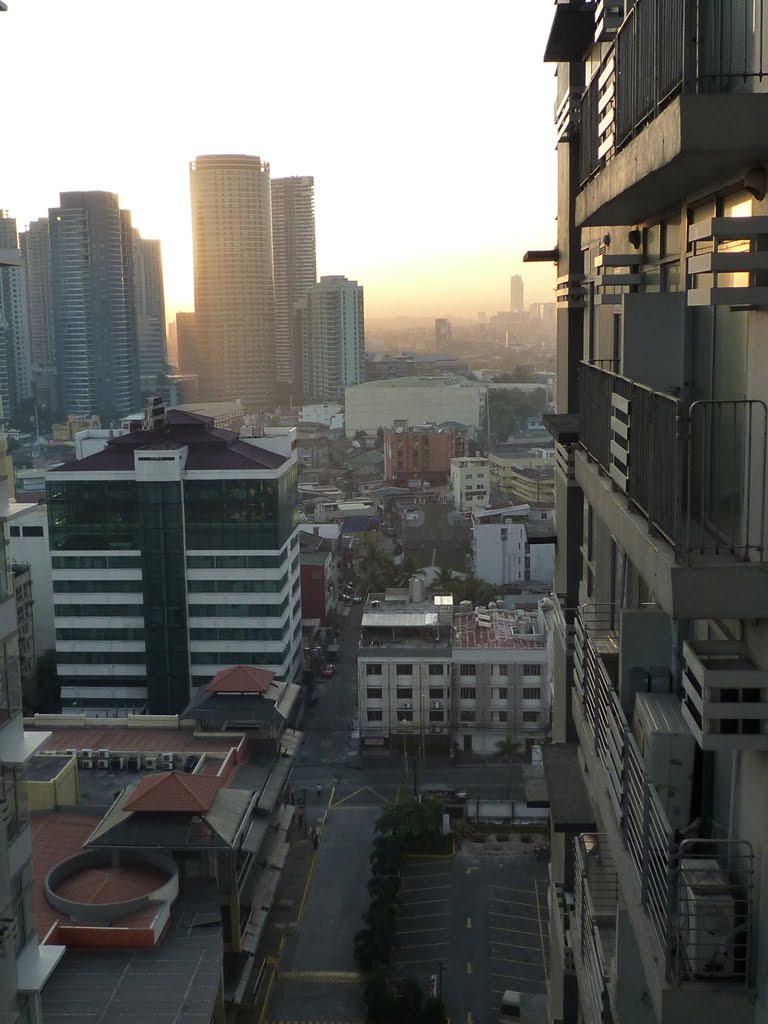
First, my flat. I was staying on Makati Avenue in the A.Venue complexes. Great view...
But from the day I got there, there was construction going on, which is definitely going to kill the view from that apartment. The guys working there would stop and wave if I stepped out on the balcony, which was pretty funny.
And talk about noisy!! What's worse, the noise wasn't just by day...they worked 24 hours a day. Check out the volume at 5am!
But living with non-stop noise is just one thing you need to get used to in Manila. I used to complain about the idiot "recycle" guys going through my area in Japan every day with loudspeaker trucks...I don't even notice them now thanks to my Manila training. Be sure to pack your ear plugs!
This and that... Being primarily a nation of practicing Catholics, there are churches everywhere. This is one at the Mall of Asia...
If churches aren't your thing, then how about an ocean view. I caught a few sunsets from here over beers.
I also went to Cebu to meet a friend for a few quick beers. There were a few food stands near the resort and people never failed to smile or say hello. And no, I didn't ever eat at this place, but I thought it was cool to see a taste of home.
I did, however, have this juice made from sugar cane. A good start to the day in Cebu.
And I got at least a few cold beers by the beach on Mactan Island.
More to follow about places to drink in Manila in Part 2. Stay tuned!
On March 11, 2011, there was a massive earthquake and tsunami about 200KM north of where I live in Chiba. People always ask how bad the damage was in my area. Although there was a huge problem with liquefaction, my apartment wasn't bad at all as you can see below.
I was so lucky not to be in Japan when the quake hit. Instead I was watching from a condo in Manila. The quake and especially the tsunami footage being shown on NHK International was just unbelievable. There were tsunami warnings in the Philippines, although as far as I know there was no damage. Still, I stayed up on the 20th floor watching on TV until it passed.
Not long after the news about the earthquake in Japan, I found a video from a geeky-sounding guy who is in my prefecture. As I'd heard, the quake started off slow and then suddenly increased in intensity. And it was long. Based on the shaking in this video, I was fearing for the worst about the condition of my place.
As it turns out, this guy is closer to Narita, so he was inside the most severe shake zone...my place was on the other side of the shaking fence, so to speak, so I didn't see any damage, and there was only a bit of mess.
First a quick glance into my back storage room when I got in. I had the bookshelf attached to the wall (standard earthquake-prep in Japan). But I guess it didn't work as it looks like an angry poltergeist went to town on my books.
Not that the messy books mean that much. Here's a shot from my other bookshelf...and as far as I can tell, it's exactly as I left it. I'm a slob, what can I say.
Part of the problem was the polarity of the shaking -- things in a kind of West-East orientation, such as the bookshelf in the top photo or my kitchen drawers below, felt the most force. My fridge was also thrown out about a foot from the wall -- which was surprising because I have a big-ass fridge. Anyway, damage to the kitchen was minimal...just my old frying pan now with a huge dent in it. So far so good...
In fact, the only thing that broke in my place was a wine glass....that fell out of the cupboard when I got home and stupidly opened it to see if anything was broken. So after a long day of travel, I christened my apartment with about a billion tiny shards of broken glass that flew all over the floor when it smashed. DUH!
Liquefaction: The place I live -- in fact all of the Tokyo Bay coast in Chiba -- is on "reclaimed land." This entire area used to be under water. So when a big earthquake hits, the water just reappears up through the ground in a process called "liquefaction." That caused more damage than anything else in this part of Chiba. Here's a video from my area on the day of the earthquake.
All that mud that starts to pour out as the flow gets stronger is the foundation of the parks, parking lots and other areas around Kaihin Makuhari, some of which sunk as much as 1 meter. Certain areas of that convention center are like walking on a roller coaster with all the troughs created when the ground leaked out from under the pavement.
Here's a few pics of the rollercoaster.
And an interesting point about language...I doubt there's a child in the English speaking world who would know the meaning of "liquefaction." Yet when I was out in the park, I saw a kid of about 5 years old talking to his dad about "ekitai gensho." So it seems that our linguistic skills really are a product of our environment!
Donating: Although I was truly lucky to have been away for the quake, the tsunami and the radiation, 20,000 or so people were not so lucky. I've asked a friend who was involved in the relief effort to send me some links to reputable relief agencies. I'll update this post when I get the links.
Sakura: Anyway, in spite of the tragic events, it was a nice day and time of the year to arrive home. Here's a shot of the cherry blossoms from my place, taken shortly after cleaning up the broken wine glass...
My last post about slobber cock in Japan got quite a response on Facebook, so here's a couple more noteworthy examples of poor product name choice in Japan: BJs at Canon, and Japanese Slats for sale in convenience stores nationwide.
The first of these two ads caught my eye more than 10 years ago, when Yoshikawa Hinano, an up and coming Japanese model became the spokesperson to promote BJ printers from Canon. The name BJ was from "Bubble Jet," since the Japanese love to shorten every English word to either letters, or some kind of abbreviation of a few syllables.
Clearly, nobody from any of the international offices took the time to drop an email to the head of the ad department in Japan. Or maybe they did, but the company knew that Hinano, being neither the brightest nor sharpest crayon in the box, would not be aware of the wider implications of her offering up BJs on TV. But I think it's the explosive enthusiasm of Hinano that makes the BJ name choice just so wrong, and yet soooo right.
Here's a still.
And the video. There's no way anybody can deny that Hinano's explosive bucket of BJ clippings was meant to be anything but overtly sexual. You gotta love the poor old lady who has to clean up the mess. Now I know how hotel maids must feel. Anyway, at the end she lets us know that a BJ from Canon is wonderful, which I'm sure nobody would dispute. The video ends with a nice touch of bestiality for a classy finish.
The other ad isn't quite so bad, but is still a bad name choice. It's Asahi's new product, Slat -- a diet alcoholic beverage that is pronounced SLUT. Niiiiice. Let's hope there's some decent cause / effect relationship from drinking the stuff.
------------------------------
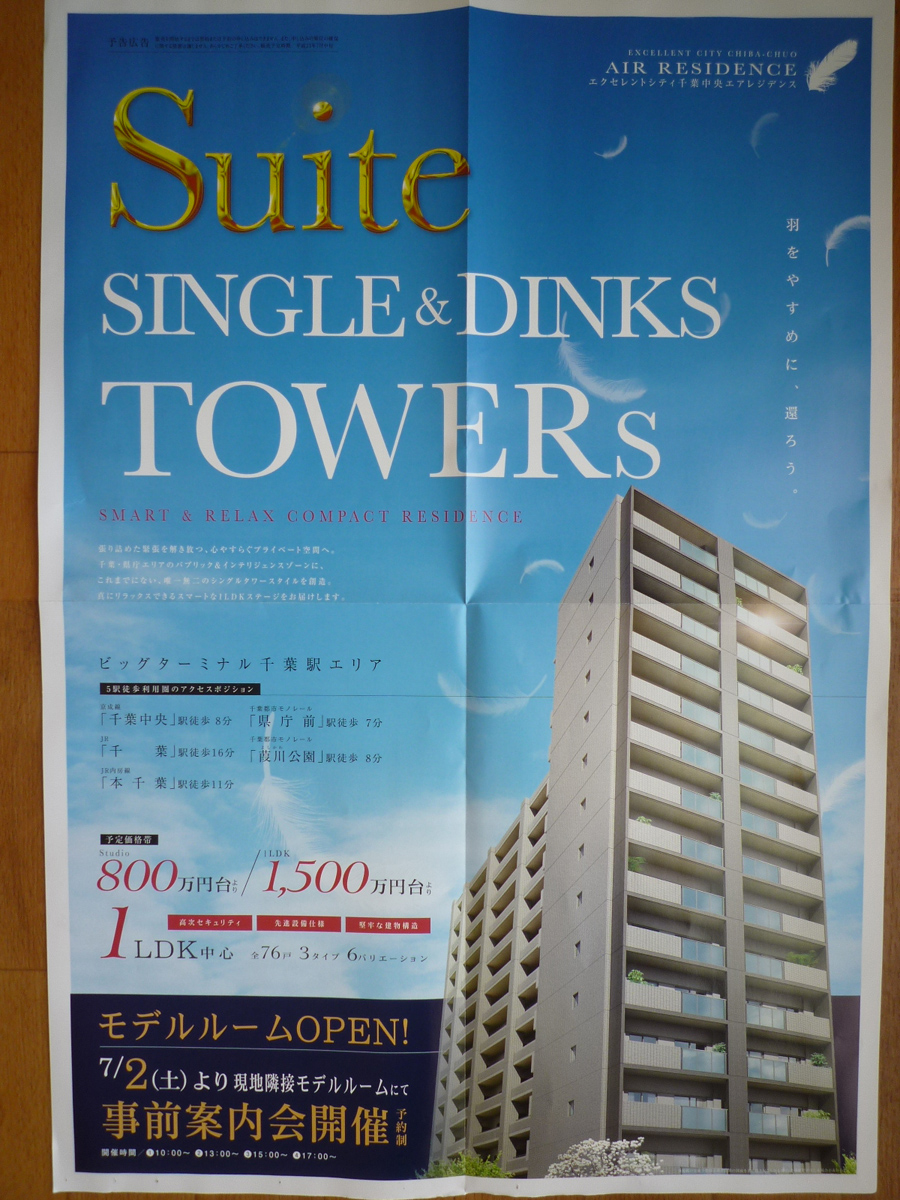
And another addition to the Wacky English thread. Just got this in my mail. I'm both impressed that somebody actually knew the abbreviation for Double Income No Kids...DINK...and amused that they are juuuuuust clueless enough to print it on the formal 60X40 cm glossy poster ad they put in my mail.
I know that teasing a non-native speaker about spelling is the lowest form of humor, but sometimes you just have to do it in the name of common decency. Particularly when it's a very successful restaurant chain like Monsoon Cafe. C'mon guys -- it would have taken but a minute to ask a foreigner if they were hungry for "slaver cock."
I had dinner with a buddy last night at the Monsoon Cafe in Ginza in Tokyo. It's located in a complex of all the restaurants run by the same group that runs the Monsoon Cafe -- it's known as the "G-Zone." Is it just me, or does that sound suspiciously close to the G-Spot. Then you look at the menu choices...
Your choice of steaming or deep frying cock. Yes, I know a cock also means a male chicken...but really. It's not the best word choice for a menu.
Yeah..."Asian Hormone," "Slaver Cock" and "Broiling Cock" also are not appealing menu choices for the discerning hetero palate.
But they did try to make an English menu. Since "Slaver" was supposed to mean "mouth watering," the waitress told me they'd corrected to the following.
Slobber Chicken. I swear to god, I'm not making this shit up. This is actually their professionally translated English menu.
All kidding aside, Monsoon Cafe has pretty decent SE Asian food for Japan. Japan usually brutalizes foreign cuisine by trying to Japanize it by adding fish eggs or mayonnaise or some other disgusting thing. But Monsoon cafe is at least in the same ballpark as the original flavors. And they have a great atmosphere -- particularly if you can make it to the Ikspiari location just beside Tokyo Disneyland. And, as a treat, on their special Slaver Cock menu they had one of my favorite Thai dishes - BBK pork neck, "Koh muu yang."
Keep up the good work, Monsoon cafe! But get a new translator! :)
Japan has definitely come a long way since I first got here 20 years ago. Then, there was one kind of coffee, one kind of burger, one kind of salad...you get the picture. Look how far we've come!
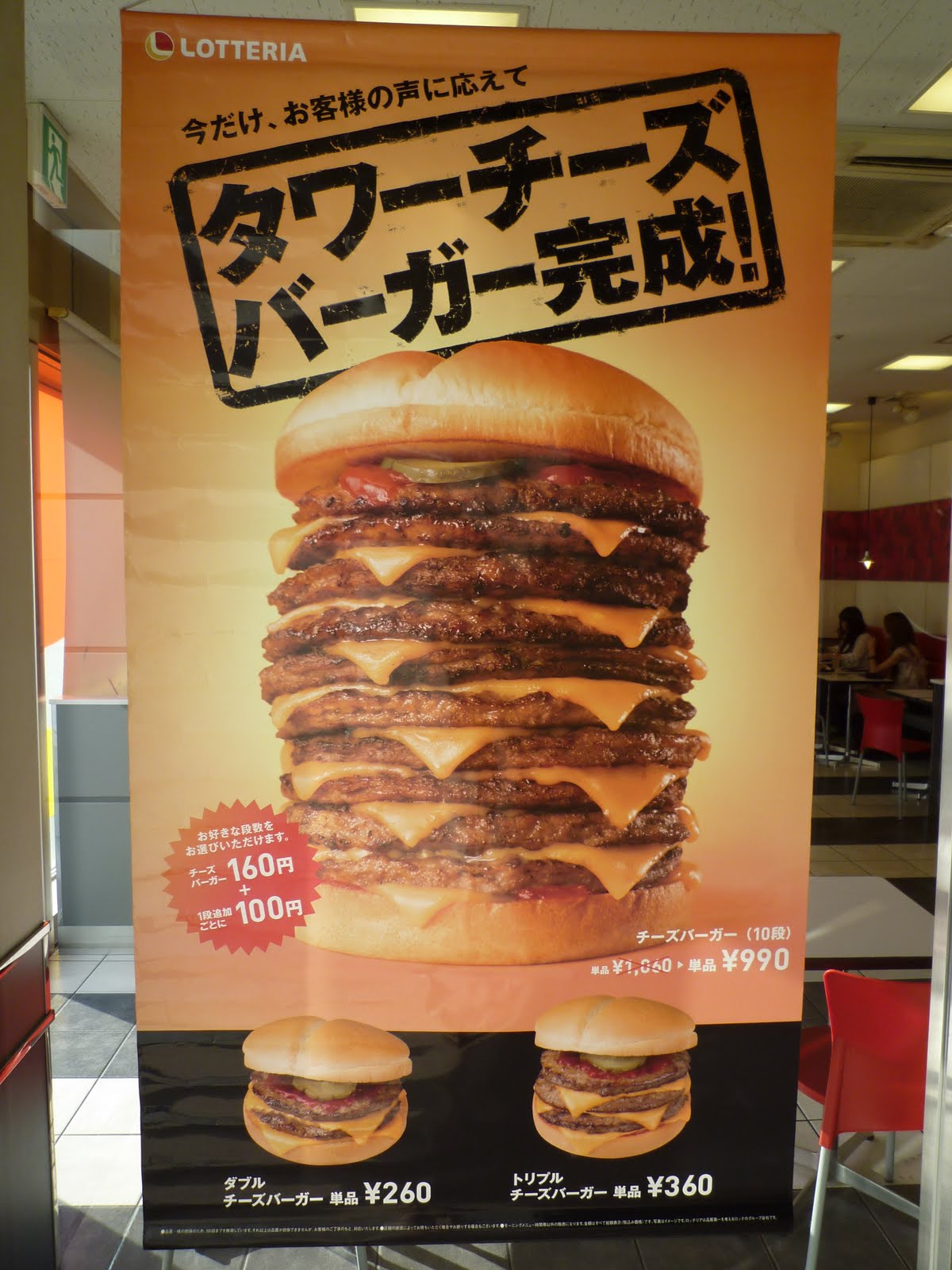
Today I walked by Lotteria -- kind of a low-rent Japanese clone of Macdonalds. You can now buy a burger with TEN patties. And for about US$11, it's not much more than a burger at a regular restaurant back home...although I'm sure not as tasty. And if I didn't want to have an artery go POP in by brain I'd try one. Actually, if you read the fine print on this poster it says "Free angioplasty with every burger!"
So I get home and I find that the only "beer" in my fridge are two non-alcoholic ones I'd bought the other day -- kind of a taste test to see which is less foul.
And check it out -- not only is the Suntory All-Free a decent tasting no-alcohol beer...it's zero calories. Holy crap. I didn't even know that zero-calorie beer existed. And I'd rather swill this stuff than diet coke, which makes me jump around like a 10-balled billy goat after drinking too many due to all the caffeine.
So Japan is starting to offer some choices. Nothing compared to what you can find in the US, Thailand or pretty much everywhere else -- but still much improved compared to before. From the world's first 10-patty burger to a zero calorie beer.